
Category: Our Approach | Est. read time: 4–5 min
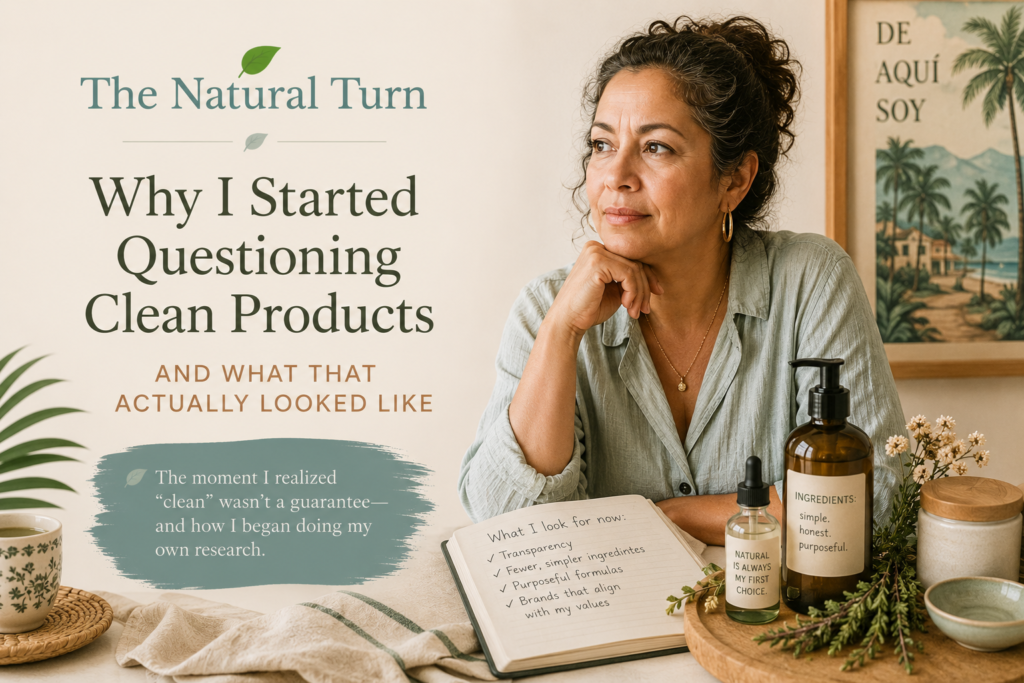
The wellness internet would have you believe that switching to clean products is a project with a clear start and end point. You throw out the bad stuff, fill your cart with the right brands, and you’re done.
That’s not what this looked like for my family.
It looked like noticing that one of us kept having skin flare-ups that didn’t track with anything obvious. It looked like swapping one product, seeing no change, then realizing I hadn’t actually read the ingredient list on the replacement. It looked like Googling terms I didn’t understand, finding conflicting information, and having to think critically about which sources had something to sell and which ones were actually trying to inform.
That process, slow, imperfect, ongoing, is what The Natural Turn is about.
What Pushed Me to Start Looking Closer
I work in marketing. Which means I understand, probably more than most, how “clean” and “natural” and “non-toxic” function as marketing language rather than regulated terms.
A product can be labeled “natural” with almost no restrictions in the U.S. “Clean” has no legal definition. “Non-toxic” is not a certification. These words are doing a job, they’re building trust, and they’re doing it without having to back up any specific claim.
I don’t say that to make you distrust everything. I say it because once I understood it, I couldn’t read a product label the same way. And I didn’t want to.
When skin sensitivity became a recurring issue in my house, I started approaching products the way I approach anything in my professional life: by asking what’s actually here, what does it do, and does the information I’m being given hold up to scrutiny?
What I’m Not Doing Here
A few things this site isn’t:
It’s not a detox plan. I’m not going to tell you to throw out everything in your bathroom and start over. That’s expensive, disruptive, and based on the assumption that everything you own is harming you, which isn’t supported.
It’s not a brand loyalty project. Some brands that market heavily in the “clean” space have ingredient lists that don’t actually differ much from conventional products. Some conventional brands have formulas I’m comfortable with. I follow the ingredients, not the marketing tier.
It’s not fear-based. The wellness space runs heavily on anxiety. This site is an attempt to do the opposite, to reduce uncertainty by actually understanding what I’m looking at, rather than outsourcing that to whoever shouts loudest online.
What I Actually Changed, and Why
Changes I’ve made have been gradual and specific:
- Laundry detergent was one of the first swaps I made intentionally, because it’s a leave-on product, your clothes sit against your skin all day. Reducing unnecessary sensitizers there felt like a reasonable place to focus.
- Lotion and body care got more scrutiny because of the surface area involved and the leave-on factor. Rinse-off products concern me less.
- Fragrance as a category became something I started reading differently after learning how little it discloses. I’ll write more on this specifically, because it deserves its own post.
- Food and diet changes have been smaller and more cautious. I’m skeptical of elimination-based frameworks that aren’t guided by actual testing.
Not everything I changed made a difference. Some swaps were neutral, same outcome, different product. That’s information too. The goal isn’t to find the perfect product. It’s to understand what I’m choosing and why.
How I Evaluate a Source
Before I trust something I read, I ask a few questions:
- Does this person or publication have something to sell? Affiliate income isn’t disqualifying, but undisclosed affiliate pressure absolutely affects what gets recommended. I disclose mine, and I try to think about it honestly.
- Is this based on studies, or on other blogs citing other blogs? A lot of wellness content is a telephone game of citations that, when traced back, lead to a single small study or no study at all.
- Is the claim specific or vague? “Chemicals are harmful” is not a claim. “This compound has been linked to contact dermatitis in patch testing studies” is a claim. I want the latter.
- Does the source acknowledge complexity? The things I trust most are the ones willing to say “it depends” and “the evidence is mixed.” The things I trust least are the ones with clean, confident answers to complicated questions.
What to Expect from This Site
I’m going to write about specific ingredients, product categories, label terminology, and the occasional process, like how I approach evaluating a new product before I bring it into the house.
I’ll be transparent about what I use, what I don’t, and what I’m still figuring out. I’ll disclose affiliate links clearly. And I’ll try to write in plain English about things that often get buried in either scientific jargon or wellness hype.
If that sounds useful, you’re in the right place. The research continues.
Nothing here is medical advice. I’m a researcher by instinct, not by credentials. Always talk to a qualified professional about your specific health concerns.